


Price:$
Popularity:★★★★
More Information
Price:$$
Popularity:★★★★★
More Information
Price:$$$
Popularity:★
More Information
Price:$$$$
Popularity:★★★
More Information
Price:$
Popularity:★★★★★
More Information
Price:$
Popularity:★★★
More Information
Low Income Rate Samples
Low Income Individual and Family Insurance Plan Benefits
U.S. citizens or tax residents may qualify for government-subsidized health insurance. Your premiums and subsidy amounts are related to the number of households on the tax return forms and the annual income. You can only enroll during a fixed three-month period each year. Therefore, having a professional, licensed and experienced insurance broker is essential to ensure the best benefits, the lowest Premiums, and the most accurate subsidies and tax credits for you. Families and individuals whose annual income is between 138% and 250% of federal poverty line have the opportunity to receive affordable plans such as Silver 94, Silver 87, and Silver 73.
Coverage Category | Silver 94 | Silver 87 | Silver 73 |
Price | $ | $$ | $$$ |
Popularity | |||
Primary Care Visit | $5 | $15 | $50 |
Specialty Care Visit | $8 | $25 | $90 |
Laboratory Tests | $10 | $30 | $50 |
Medical Deductible | $0 | $1,400 | $5,200 |
Pharmacy Deductible | $0 | $50 | $50 |
Inpatient Hospital Care | 10% | 20%* | 30%* |
Outpatient Surgery | 10% | 20% | 30% |
Individual Annual Out-of-Pocket Maximum | $1,400 | $3,350 | $8,100 |
Benefits Overview | |||
Benefits of Listening | |||
*Price is after pharmacy deductible amount is met. Drug prices are for a 30 day supply. Any annual benefits, deductibles, and annual payment caps are based on calendar years, i.e., as of December 31. The information above provides a basic overview of benefits. For detailed coverage and actual terms, please review the policy carefully. | |||
Basic Insurance Plan Benefits
Coverage Category | Bronze 60 | Silver 70 | Gold 80 | Platinum 90 | Bronze HDHP | Minimum Coverage (Under 30 Years Old) |
Price | $ | $$ | $$$ | $$ | $ | $ |
Popularity | ||||||
Annual Wellness Exam | $0 | $0 | $0 | $0 | $0 | $0 |
Primary Care Visit | $60 | $50 | $40 | $15 | Full cost until OOP | $0*③ |
Specialty Care Visit | $95*③ | $90 | $70 | $30 | Full cost until OOP | Full cost until OOP |
Laboratory Tests | $50 | $50 | $40 | $15 | Full cost until OOP | Full cost until OOP |
Outpatient Surgery | 40%* | 30% | $190 copay 30% co-ins | $95 copay 10% co-ins | Full cost until OOP | Full cost until OOP |
Inpatient Hospital Care | 40%* | 30%* | $375/ per day 30% co-ins | $225/per day 10% co-ins | Full cost until OOP | Full cost until OOP |
Individual Medical Deductible | $5,800 | $5,200 | $0 | $0 | $7,200 | $10,600 |
Individual Annual Out-of-Pocket Maximum | $9,800 | $9,800 | $9,200 | $5,000 | $7,200 | $10,600 |
Benefits Overview | ||||||
Benefits of Listening | ||||||
*Full cost until deductible is met. ③Copay is for any combination of services (specialist) for the first three visits. After three visits, future visits will be at full cost until the medical deductible is met. All plan benefits are based on the procedure codes that providers submit to insurance company. Different procedure code will result in different copay amount. See plan Evidence of Coverage. Any annual benefits, deductibles, and annual payment caps are based on calendar years, i.e., as of December 31. The information above provides a basic overview of benefits. For detailed coverage and actual terms, please review the policy carefully. | *30周歲以下才能購買Minimum Essential Coverage計劃,購買此計劃無法享有加州全保政府輔助。 | 注:任何年度福利、自付額、年度付款上限,都以自然年Calendar Year為單位,即截止12月31日爲止。 | ||||
Health Insurance FAQs
Yes, the penalty for each uninsured resident will be at least $900 per adult and $450 per dependent child under 18 in the household. A family of four that goes uninsured for the whole year would face a penalty of at least $2,700.
If you apply for health insurance through Covered California, you will still have the opportunity to apply and qualify for subsidies.
For 2026, Covered California’s Open Enrollment Period is from November 1, 2025, to January 31, 2026.
Individuals could only enroll in health insurance or switch plans during the Open Enrollment Period, which was only a few months of the year. After the enrollment period was over, if they did not qualify for special enrollment, individuals would no longer be able to apply for health insurance or make adjustments to their plans.
In 2026, premiums are rising 10.3% on average and benefits are shrinking. Silver Plans face the biggest impact, with higher deductibles and out-of-pocket limits.
Switching from a PPO to an HMO or downgrading your plan (Platinum → Gold → Silver) can help save costs. Opening a Traditional IRA may reduce your household income for health insurance, helping you qualify for more subsidies and better coverage.
For 2026, Covered California’s Open Enrollment Period is from November 1, 2025, to January 31, 2026.
if you are looking for a new plan effective on January 1st, 2026, you need to complete the application before December 31st, 2025.
If you are looking for a new plan effective on February 1st, 2026, you need to complete the application before January 31st, 2026.
For 2026, Covered California’s Open Enrollment Period is from November 1, 2025, to January 31, 2026.
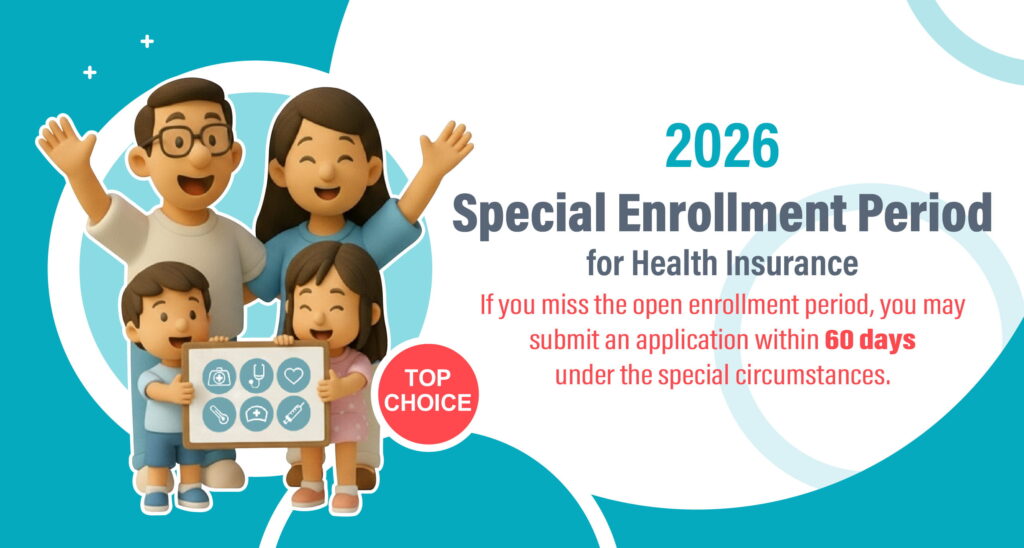
If you miss this open enrollment period, you will not be able to purchase health insurance unless you qualify for special enrollment, in which you would have to apply for health insurance within 60 days of your qualifying life event which include:
1. A child is born, adopted or received into foster care; your child is placed into foster care or is up for adoption
2. Loss of employer-sponsored coverage, or your COBRA coverage is exhausted (Note: Not paying your COBRA premium is not considered loss of coverage)
3. Loss of Medi-Cal coverage
4. Moved to California from out of state or moved within California and gained access to at least one new Covered California health insurance plan
Without an SSN, you cannot apply for most health insurance plans used by U.S. residents. Standard travel insurance often does not cover routine medical needs, and pre-existing conditions such as diabetes, high blood pressure, or pregnancy are frequently excluded. For seniors 65 and older, not having an SSN also means you cannot apply for federal Medicare.
But don’t worry! In this situation, you can contact KCAL Insurance, and we will help you find the best health insurance plan based on your needs and circumstances, ensuring reliable and comprehensive coverage so you can confidently handle all your healthcare challenges.
Call KCAL Insurance today.
Covered California and the IRS are connected in the sense where Covered California uses the household income and household size on the 1040 tax form to calculate health insurance premiums and check for eligible federal subsidies for the applicant. If you are a resident with a taxable income (citizen, green card holder, working visa holder, etc.), and your family income meets the requirement, you may qualify for subsidies and medical costs.
Based on your annual household income, you may qualify for federal subsidies in the form of Medi-Cal, premium assistance, or cost-sharing reductions. To determine whether you qualify for premium assistance, please refer to this chart.
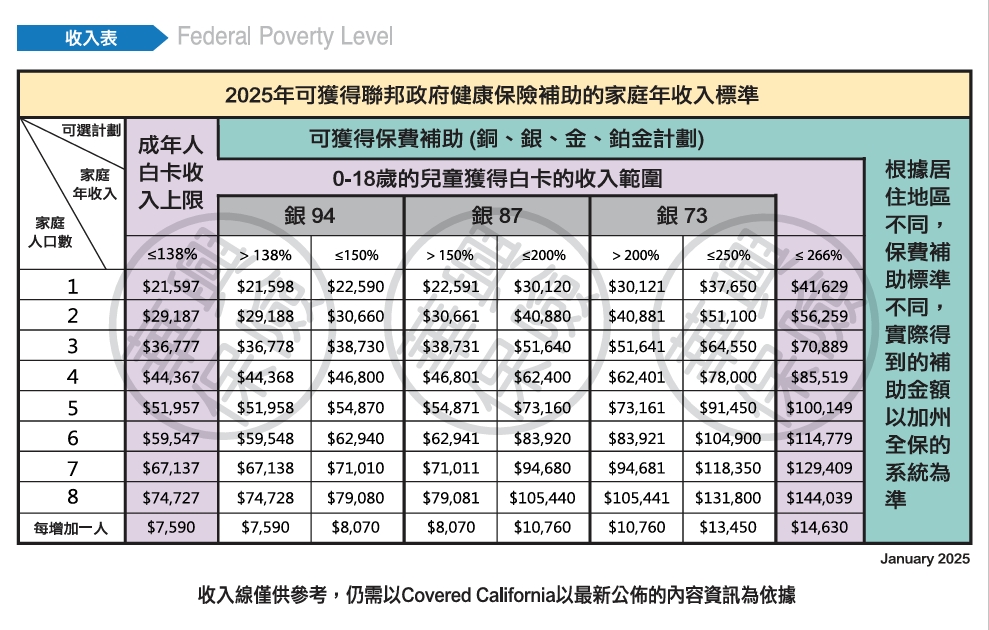
To find your adjusted gross income, take a look at Line 2A, 6A and 11 on Form 1040.
If you have your paycheck statement, rental income, interest income, or income from the EDD, you can use it as proof of income. If you do not have any valid documents, you can ask your accountant or employer to provide you with a signed proof of income statement.
If you have non-taxable social security benefit, income living abroad or non-exempt interest, you should include these as income to calculate the accurate MAGI amount.
*Please consult your CPA for further tax questions.
If you want to enroll for health insurance with subsidies during open enrollment, you cannot cancel your Medi-Cal coverage.
If you do not need subsidies, you can cancel your Medi-Cal coverage and purchase health insurance without subsidies during open enrollment.
You will need to provide proof of income to the county office where you reside to update your family income, and then you can apply for general health insurance.
PPO premiums continue to increase as it has done so in the past few years. If your health is in good condition and you do not expect to go to the doctor’s often, then you can consider switching to an HMO or EPO plan.
You can also open an IRA to reduce the taxable income so that when you apply for government subsidies you will have lower premiums and get better benefits.
If your doctor is not contracted with your current insurance company, then you can switch to an insurance company that your doctor is in contract with.
If your primary care physician only accepts group health insurance and you are self-employed, or a 1099 employer, feel free to contact KCAL to see what your options are.
Since the benefits would be the same, one way to help you choose the right insurance company is based on the quality of service and the size of the medical network.
If you want to be able to see a doctor easily and don’t want to delay treatment due to conflicts with your medical network, then Kaiser Permanente would be the best option. Its comprehensive medical system and latest medical equipment make it easy to see a doctor.
If the company you work at offers you and your family group health insurance, you won’t be able to purchase insurance with government subsidies for you and your family. As long as the company-provided health insurance is considered affordable and meets certain standards, then maybe you qualify for subsidies of Family Glitch.
If you and your family are applying for subsidies when your company offers group health insurance to you and your family, then your subsidies will be returned to the government.
However, if the out-of-pocket amount you have to pay for the employer-sponsored plan’s premium (not including the premium your family pays), then you and your family can apply for government subsidies for health insurance after submitting necessary documentation.
“COVERED CALIFORNIA,”“CALIFORNIA HEALTH BENEFIT EXCHANGE”, AND THE COVERED CALIFORNIA LOGO ARE REGISTERED TRADEMARKS OR SERVICE MARKS OF COVERED CALIFORNIA, IN THE UNITED STATES.
This website is owned and maintained by KCAL Insurance Agency, which is solely responsible for its content. This site is not maintained by or affiliated with Covered California, and Covered California bears no responsibility for its content. The e-mail addresses and telephone number that appears throughout this site belong to KCAL Insurance Agency and cannot be used to contact Covered California.