
LA County’s 2026 HWPO Goes Live: Hotels Brace for Final Compliance Deadline

1. Employee Safety Measures: Hotels must provide emergency alert devices, ensure appropriate staffing levels, conduct required safety training, and maintain proper documentation.
2. Workload and Hour Restrictions: The ordinance sets limits on the number of rooms and total square footage an employee may be assigned to clean within a shift.
3. Mandatory Training and Evaluations: Required training covers worker rights, human‑trafficking and violence‑prevention protocols, and disease‑prevention practices.
4. Posting and Notification Requirements: Employers must inform both current and newly hired employees of the ordinance and display designated notices and signage in specified locations.
Officials advise hotels within the ordinance’s jurisdiction to conduct immediate policy reviews, identify compliance gaps, and strengthen communication with employees to ensure clarity around rights and responsibilities. Legal consultation and updated labor‑law posters are available through the resources provided below.
As AI Reshapes the Labor Market, Experts Warn of Job Displacement Across Key Sectors
The impact of artificial intelligence on the labor market is becoming increasingly visible. A recent research report released by AI company Anthropic identifies four sectors facing the highest risk of AI‑driven job displacement: computer and mathematics, office and administrative support, business and finance, and sales.
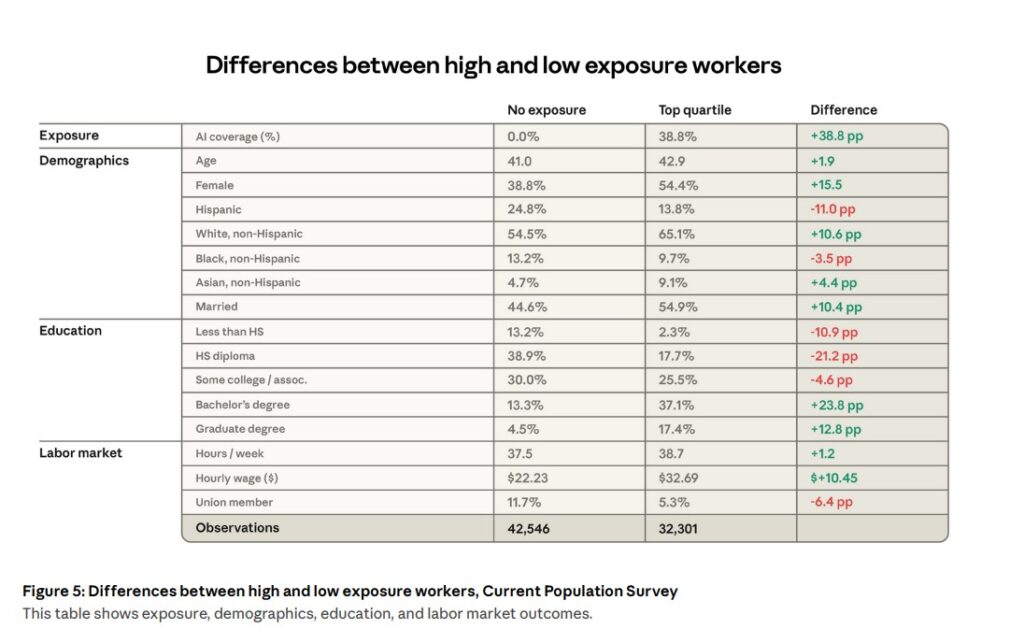
Citing projections from the U.S. Bureau of Labor Statistics, the report notes that by 2034, occupations with a high overlap with AI‑related tasks are expected to see slower employment growth. Workers currently most exposed to AI tend to share several characteristics: they are generally older, include a slightly higher proportion of women, and hold higher levels of education and income.
Anthropic emphasizes that AI has not yet reached its full theoretical capabilities and that real‑world applications remain limited. However, since late 2022, employment trends among younger workers have already shifted. Jobs with high AI exposure have seen a noticeable decline in hiring for workers aged 22 to 25, with employment rates in these roles dropping between 6% and 16%.
A separate report from global consulting firm Korn Ferry further underscores the shifting labor landscape. According to its 2025 findings, more than 40% of companies plan to replace existing roles with AI technologies. Back‑office and entry‑level positions appear to face the greatest exposure, accounting for 58% and 37% of planned replacements, respectively. Taken together, the data suggest that AI’s impact on the workforce is already quietly taking shape. As organizations plan future hiring strategies, experts say employers will need to take a closer look at which foundational roles are being reshaped—or potentially phased out—by emerging AI capabilities.
Compensation Management: Training Frontline Leaders to Navigate Salary Discussions
Finally, attention is turning to how companies can better prepare frontline managers to handle employee questions about compensation.
According to the Vice President of Product Strategy at Salary.com, organizations typically consider a range of factors when determining salary adjustments, including market conditions, individual performance, and promotion history. Yet by the time these decisions reach frontline managers, the message often becomes oversimplified, leaving employees with little more than a brief explanation such as, “Your salary is increasing by 3% this year.”

Training sessions, they say, should be conducted during work hours to give managers adequate time to ask questions and practice real‑world conversations. Supporting materials can also play a key role. Companies are encouraged to prepare a one‑page summary outlining their compensation philosophy, along with key talking points to help guide discussions.While employers cannot predict every question employees may ask, they can prepare managers for the most common ones. Examples include:
When employees ask follow‑up questions such as “Why did I only receive a 3% increase?”, frontline managers often struggle to respond confidently. Experts note that this is where a company’s one‑page summary of its compensation philosophy becomes especially useful, providing managers with clear, consistent language to explain the rationale behind pay decisions.
When employees ask,“How are salary decisions made?”, managers need to be able to explain the process using market data and the company’s compensation positioning. Experts note that grounding the explanation in objective information helps reduce speculation and prevents employees from drawing their own conclusions.
When employees ask how they can earn a larger raise next year, experts say managers should be prepared to shift the conversation toward development planning. Forward‑looking discussions not only help reduce employee resistance but also allow managers to outline concrete steps for growth. HR departments can support this process by providing standardized development‑planning guidelines, helping managers keep the conversation focused on future performance and positive outcomes.
Overall, organizations are finding that the ability of frontline managers to clearly and accurately communicate compensation logic is becoming increasingly critical.
KCAL HR Weekly: Brings you the latest insights on U.S. business operations and talent management.
All in just five minutes.
This article is intended for general informational purposes only and should not be considered legal, tax, or accounting advice. Readers are encouraged to seek professional guidance for advice tailored to their specific circumstances. Click here to schedule a complimentary corporate legal consultation.